
Understanding Modern Data Centres: Architecture, Operations & UK Context
What Is a Data Centre?
A data centre is a purpose-built facility that houses compute, storage and networking equipment essential for modern digital services — from cloud apps and streaming media to e-commerce and critical government systems. These facilities ensure data is processed, stored and delivered securely, reliably and at scale, 24/7.
In the UK, data centres are now recognised as critical national infrastructure, on par with energy and transport systems, due to their role in underpinning economic activity and public services.
Core Technical Components of a Data Centre
1. Compute and Storage Platforms
These are the servers, storage arrays (SAN/NAS), and hyperconverged systems that run applications and house data. Modern deployments often use virtualization and containerisation to enhance utilisation and flexibility.
2. Networking Fabric
Data centres rely on a high-capacity, low-latency network backbone to interconnect equipment internally and externally:
- Top-of-Rack (ToR) Switches: Aggregation points for rack servers.
- Core Routers and Switches: Provide resilient layer-3 connectivity.
- Peering and Internet exchange connectivity — e.g., networks like the London Internet Exchange (LINX) enable direct interconnection between service providers and content networks.
Redundancy and diverse fibre paths are standard to avoid a single point of failure.
3. Power Infrastructure
Data centres require a continuous and stable power supply:
- Utility feed + transformers
- Uninterruptible Power Supplies (UPS): Provide ride-through power during short outages.
- Backup Generators: Diesel or gas generators sustain full runtime during prolonged utility loss.
- Power distribution units (PDUs) deliver conditioned power to racks.
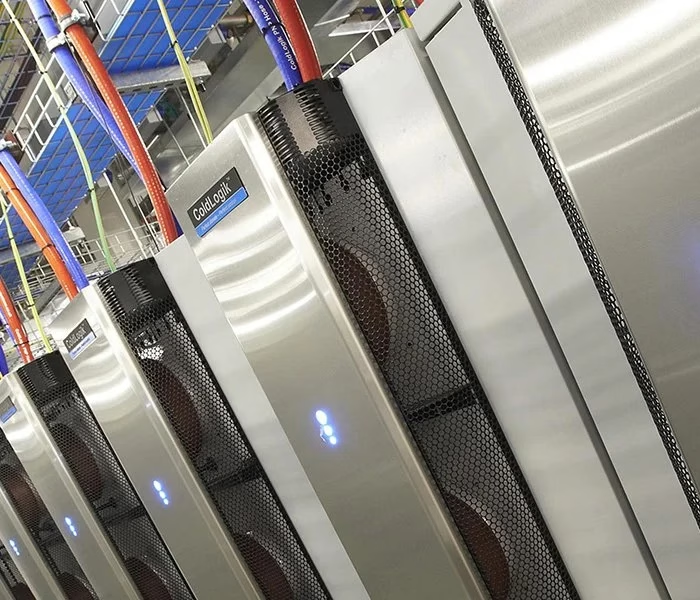
4. Cooling and Environmental Control
Servers generate significant heat — without adequate cooling, performance and reliability degrade:
- Airflow management: Hot-aisle/cold-aisle containment to separate intake and exhaust air.
- CRAC/CRAH units: Precision cooling tailored for high-density racks.
- Advanced cooling: Liquid cooling and free-cooling systems reduce overall energy use.
PUE (Power Usage Effectiveness) is the key efficiency metric; lower figures indicate more energy used by IT equipment rather than infrastructure.
5. Security Systems
Physical and logical security protections include:
- Biometric access control, CCTV and guards
- Fire detection and suppression
- Network firewalls, DDoS mitigation and intrusion detection systems
Types of Data Centres Found on DataCentres.UK
Data centres vary by size, ownership and purpose:
- Enterprise Data Centres: On-premise facilities dedicated to a single organisation.
- Colocation Facilities: Third-party operated sites where customers lease space, power and network.
- Hyperscale Data Centres: Massive sites built to support cloud giants and high-performance workloads.
- Edge Data Centres: Smaller facilities located closer to end users to reduce latency.
High Availability and Resilience
Data centres adopt tiered redundancy to ensure uptime:
- N, N+1, 2N and beyond: Robust power and cooling redundancy topologies.
- Disaster Recovery and Business Continuity: Many centres integrate with DR plans, offering replication and rapid failover. DataCentres.UK includes listings for Disaster Recovery and Data Backup services to support these strategies.
Resilient design anticipates hardware failure, maintenance activities and utility interruptions without service degradation.
Operational & Regulatory Landscape in the UK
Critical National Infrastructure
The UK government has formally designated data centres as part of the nation’s essential infrastructure, strengthening requirements for resilience, security and continuity. This status aligns data centres with other critical systems like power and water supply.
Planning and Sustainability
Local planning policies increasingly consider data centre energy usage, grid impact and environmental footprint. Data centre power demand — and associated cooling energy — can drive significant electricity consumption growth.
Sustainable practices are becoming mainstream:
- Waterless cooling and closed-loop systems are reducing direct water use in many facilities.
- Renewable energy sourcing and carbon-efficient designs are now key differentiators in the market.
Emerging Trends in UK Data Centre Technology
AI-Driven Operations
Artificial intelligence is being used for predictive maintenance, energy optimisation and workload balancing — lowering operating costs while maintaining high performance.
Hybrid Infrastructure
Many enterprises are blending colocation with cloud and edge resources to balance cost, performance and control. This hybrid model improves business agility while leveraging strategic data centre locations.
Sustainability and Efficiency
With rising scrutiny of power and water use, data centres are innovating:
- Power Usage Effectiveness (PUE) improvements
- Advanced thermal designs
- Carbon accounting tools integrated into management dashboards
Why This Matters for Infrastructure Buyers
Data centres are no longer “just facilities” — they are strategic IT assets that influence uptime, compliance, cost control and innovation. Whether selecting colocation space in London, Edinburgh or Manchester, understanding these technical fundamentals helps you align infrastructure decisions with organisational goals.
Platforms like DataCentres.UK simplify discovery by aggregating listings for colocation, dedicated servers, connectivity and backup services in one place, enabling informed procurement choices.
In a world increasingly driven by digital services, data centres form the backbone of modern computing. Their architecture — from power and cooling systems to network fabrics and security controls — must be engineered for maximum uptime, efficiency and adaptability. As the UK continues to scale its digital economy, demand for resilient, secure and sustainable data centre infrastructure will only grow.